How to Meal Plan for Weight Loss — A UK Beginner's Guide
Meal planning is one of the most practical tools for weight loss, because it moves the decision away from the moment you are hungry and tired. Deciding on Sunday what Wednesday looks like means the calorie maths is done once, the shopping matches the plan, and there is something to eat when willpower is low. This step-by-step guide explains exactly how to start meal planning for weight loss in the UK — from calculating your calorie target to building your first shopping list.
Why Meal Planning Works for Weight Loss
The main reason diets fail is not lack of willpower — it is a lack of planning. When you are hungry, tired, and staring into the fridge with no idea what to cook, you make poor decisions. Meal planning eliminates that scenario. By deciding in advance what you will eat, you remove the friction, reduce food waste, and make it far easier to stick to your calorie target.
A 2017 study in the International Journal of Behavioral Nutrition and Physical Activity found that meal planners were significantly less likely to be overweight and reported better overall diet quality than non-planners. Another benefit: when you buy specific ingredients for specific meals, you spend less on food overall and waste far less.
Step 1: Set Your Daily Calorie Target
Before you plan anything, you need a calorie target. This is determined by your Total Daily Energy Expenditure (TDEE) — the total number of calories your body burns each day — minus your desired deficit.
A safe and effective deficit for most people is 300–500 calories below TDEE. This produces weight loss of 0.3–0.5 kg per week. Use our calorie deficit guide to calculate your TDEE, or simply use our meal plan generator, which lets you set your calorie target directly.
Common starting points for UK adults: 1,500 calories per day for women seeking moderate weight loss; 1,800 calories for women who are more active or want a gentler approach; 1,800–2,000 calories for sedentary to lightly active men; 2,000–2,200 for active men.
Step 2: Choose Your Meals
Once you have a calorie target, you need meals that hit that target while keeping you full and satisfied. The most effective approach is to anchor each meal around a protein source and then fill in with vegetables and a moderate portion of complex carbohydrates.
A simple daily structure that works for most people: a high-protein breakfast of 350–450 kcal; a filling lunch of 400–500 kcal; a satisfying dinner of 500–600 kcal; and one or two snacks totalling 150–300 kcal. That adds up to roughly 1,400–1,850 kcal, so scale the portions up or down to match your own target.
Use our free meal plan generator to let AI do this work for you. Input your calorie target, preferred supermarket, dietary requirements, and cooking time, and receive a complete 7-day plan with meals, calories, protein, and a shopping list in under 30 seconds.
Step 3: Build Your Shopping List
A good meal plan is only as good as its shopping list. Once you know your meals for the week, list every ingredient needed, group them by supermarket category (produce, meat, dairy, dry goods), and check what you already have at home.
Shopping from a list prevents impulse buys, reduces food waste, and keeps your weekly spend predictable. Sticking to your chosen supermarket — whether Tesco, Aldi, Sainsbury's, or Asda — simplifies this further. Our generator automatically produces a categorised shopping list alongside your meal plan.
Buy versatile staples in bulk: chicken breast, oats, brown rice, eggs, and tinned fish are all cheaper per serving when bought in larger quantities and last well in the fridge or freezer.
Step 4: Batch Cook at the Weekend
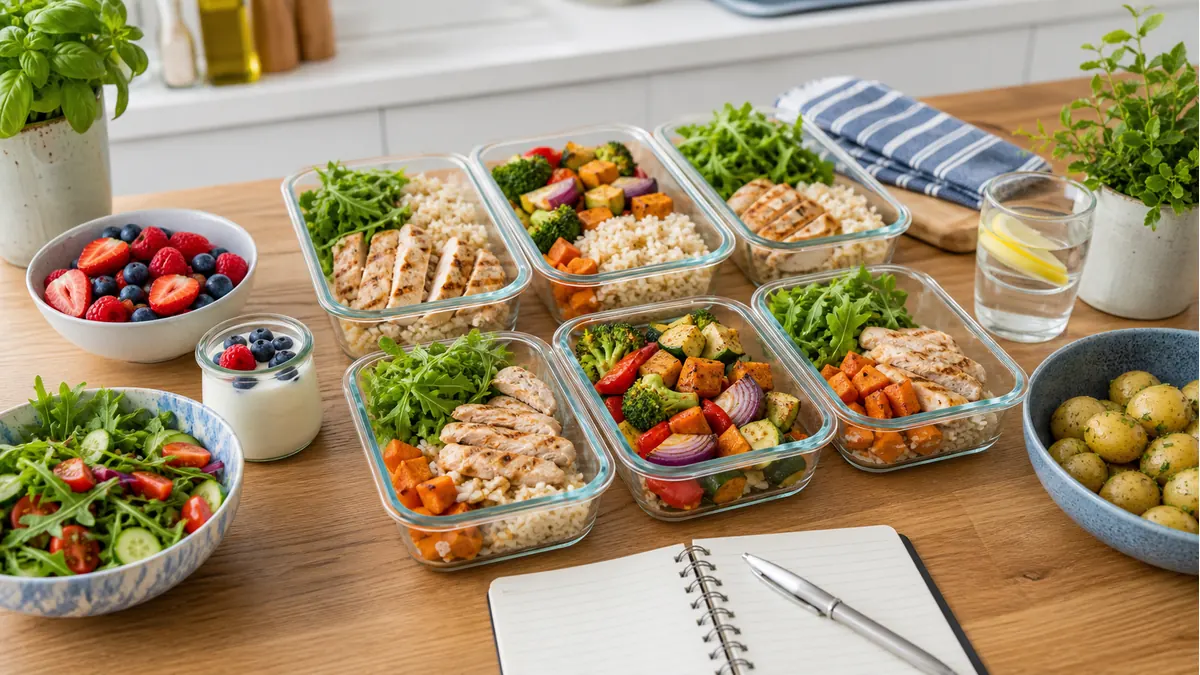
The biggest barrier to sticking to a meal plan during the week is time. Batch cooking — preparing several meals or components in advance on a Sunday — solves this problem. Typical batch-cook items include cooked chicken breast, eggs, grains, roasted vegetables, soup and chilli. Keep cooked leftovers in the fridge for the first couple of days, freeze later-week portions, and treat cooked rice as stricter: cool it quickly, refrigerate promptly, and use it within about 24 hours.
A two-hour Sunday batch cook can provide all lunches for the week and simplify dinner preparation significantly. Even just pre-cooking your protein and grains for the week removes the main obstacle to healthy eating on busy weeknights.
Step 5: Track and Adjust
Weigh yourself once a week (same day, same time, after waking) and track the trend over several weeks rather than reacting to day-to-day fluctuations. If you are not losing weight after two to three weeks, review your tracking accuracy — underestimating portion sizes is the most common reason a meal plan stops working.
Adjust your calorie target if needed. As you lose weight, your TDEE decreases slightly, so you may need to reduce your target by 50–100 calories every few weeks to maintain the same rate of progress. This is normal and expected.
Be flexible. One high-calorie day does not ruin a week of effort. If you go over your target at the weekend, simply return to your plan on Monday without guilt. The key metric is average weekly calories, not any single day.
Common Meal Planning Challenges and How to Solve Them
Boredom with the same meals: Introduce one or two new recipes per week rather than eating exactly the same plan every week. Our generator creates a different randomised plan each time, making variety easy to build in.
Not enough time to cook in the evenings: Choose recipes with under 20 minutes of active cooking time. Grilled chicken, baked fish, stir-fries, and egg dishes are all fast. Batch-cook the time-intensive components (rice, lentils, roasted veg) at the weekend.
Eating out or social events: Look up the menu in advance and identify the highest-protein, lowest-calorie options. Large UK chains must show calories on their menus, and many also publish full nutrition information online. Grilled proteins with vegetables and minimal sauces are usually a safe choice.
Lack of motivation: Focus on non-scale victories — better sleep, more energy, clearer skin, clothes fitting better. These changes often happen before significant weight loss is visible on the scale.
Frequently Asked Questions
How many meals a day should I plan for weight loss?
Three main meals (breakfast, lunch, dinner) with one or two snacks works well for most people. This structure distributes protein across the day and prevents the extreme hunger that leads to overeating. Meal frequency itself does not directly affect weight loss — total daily calories do.
How long does meal prep last in the fridge?
For UK food-safety guidance, eat cooked leftovers kept in the fridge within 2 days, and use cooked rice within about 24 hours. A Sunday cook can still cover a working week if you refrigerate the first couple of days and freeze later portions.
How much does meal planning save per week?
Replacing five bought lunches (£5–7 each) with home-prepared equivalents (£1.20–1.80 each) saves roughly £16–29 per week — about £800–1,500 a year. Planning dinners as well also cuts food waste and impulse takeaway spending.
Want this as a full 7-day plan?
We'll email the matching plan, its shopping list and a printable copy.
We'll send: Weight Loss Meal Plan — 1,500 kcal
Want a new plan every week? Join the MealPrep+ waitlist.
Find Your UK Supermarket Meal Plan
Answer seven quick questions to find a realistic weekly plan for your supermarket, calorie target, budget and dietary preferences.
Find My Meal Plan →