Batch Cooking for Beginners UK: 5 High-Protein Meals in 2 Hours
Batch cooking is the single most effective habit for eating well during a busy week. Two hours on a Sunday can set up five ready-to-eat meals that cost a fraction of takeaways and meal deals — with the first couple of days kept chilled and later portions frozen. This guide walks a complete beginner through a structured Sunday batch-cook session that produces five high-protein lunches and dinners for under £30.
As an Amazon Associate I earn from qualifying purchases. Product prices and availability can change on Amazon UK.
Containers for the Session Above
The glass and budget plastic sets mentioned in the equipment list.
Product formats and care details follow current Amazon listing or manufacturer information, not hands-on testing. Check the live listing before buying.
Containers for the Session Above: quick comparison
Compare 2 options first, then scroll for the longer buying notes.
- Material
- Glass
- Price
- Mid-range
Best balanced glass set
5 pack - 1 compartmentA strong mid-range pick for people moving from plastic to glass meal prep containers.
- Material
- Glass
- Format
- 5 pack
- Layout
- 1 compartment
Avoid if: You commute with several meals at once and need lightweight tubs.
- Material
- Reusable plastic
- Price
- Budget
Best starter pack
20 pack - 3 compartmentsA large divided-container pack for people who want low cost per tub and enough boxes for serious batch cooking.
- Material
- Reusable plastic
- Format
- 20 pack
- Layout
- 3 compartments
Avoid if: You want a premium eating experience or stain-resistant bases.
- Material
- Glass
- Price
- Mid-range
Harbour Housewares Glass Containers with Airtight Lids
A strong mid-range pick for people moving from plastic to glass meal prep containers.
Best for: A balanced glass upgrade without paying premium-set prices
Buy if: You want one sensible glass lunch box for each weekday.
Avoid if: You commute with several meals at once and need lightweight tubs.
- Price level
- Mid-range
- Material
- Glass
- Set format
- 5 pack
- Before buying
- Check the live Amazon listing
Watch out: Glass is heavier than plastic for commuting.
See Amazon price →Pros, cons and key features
- Layout
- 1 compartment
- Storage fit
- Best all-round workweek glass setup
- Good workweek format
- Glass resists stains
- Strong mid-range value signal
- Heavier than plastic
- Only five containers
- Airtight-style lids for fridge storage
- Glass base avoids staining from curry or tomato sauce
- Good everyday size for weekday lunches
- Material
- Reusable plastic
- Price
- Budget
Vinsani 3 Compartment Meal Prep Containers
A large divided-container pack for people who want low cost per tub and enough boxes for serious batch cooking.
Best for: Bulk weekday lunches, freezer portions, and beginner meal prep
Buy if: You want the lowest cost per usable lunch tub.
Avoid if: You want a premium eating experience or stain-resistant bases.
- Price level
- Budget
- Material
- Reusable plastic
- Set format
- 20 pack
- Before buying
- Check the live Amazon listing
Watch out: Plastic tubs can stain with tomato sauces or curries over time.
See Amazon price →Pros, cons and key features
- Layout
- 3 compartments
- Storage fit
- Excellent for freezer batches and high-volume prep
- Strong container count
- Clear portion sections
- Good for freezer rotation
- Can stain with tomato or curry
- Still takes cupboard space
- Three compartments for protein, carbs, and vegetables
- Lightweight enough for commuting or gym bags
- Good choice when you want many tubs for batch cooking
A Rice Cooker Speeds This up Further
Useful if you would rather not watch a pan of rice while everything else is going. The basic model is enough for rice alone; the COSORI is only worth the difference if you also want steaming and slow cooking from the same appliance.
Russell Hobbs Electric Rice Cooker, 27030
A straightforward one-button rice cooker with a removable non-stick bowl and steamer basket, sized for a realistic weekly rice batch.
Best forSimple, reliable rice batches for meal prep, around 6 portions
Good to knowBasic model without a delay timer; best for cooking rice in one go rather than scheduling ahead.
See Amazon price →COSORI Rice Cooker, Slow Cooker & Steamer, 5L
A larger multi-function cooker with fuzzy logic temperature control, useful if you want a single appliance covering rice, steamed vegetables and slow cooking.
Best forPeople who want one appliance that covers rice, steaming and slow cooking
Good to knowLarger footprint than a dedicated rice cooker, so check you have the counter or cupboard space.
See Amazon price →Why Batch Cooking Works
The biggest threat to a healthy diet during the week is a moment of exhaustion combined with an empty fridge. Batch cooking eliminates that scenario. When Tuesday evening arrives and you have already cooked chicken, rice, and roasted vegetables waiting in the fridge, the path of least resistance is the healthy option.
The financial case is equally compelling. A bought lunch from a café or sandwich shop often costs £5–7 (a supermarket meal deal is nearer £4–5). A batch-cooked equivalent (chicken rice bowl, pasta salad, wrap) costs £1.20–1.80. Replacing five £5–7 lunches a week saves roughly £16–29 per week — about £800–1,500 a year. Factor in avoided takeaways and the savings grow further.
What You Need Before You Start
Equipment: a large baking tray, a large saucepan or rice cooker, a frying pan, a sharp knife, a chopping board, and 5 × 1-litre sealable containers. Glass containers (available on Amazon for £15–20 for a 5-pack) last for years and go in the dishwasher and microwave. If you are new to meal prep, plastic containers (£8–12 at Ikea or Tesco) work fine to start.
Ingredients for this session: 1 kg frozen chicken breast (Aldi, ~£3.49), 500 g brown rice (Aldi, ~£0.89), 1 kg mixed frozen vegetables (Aldi, ~£0.95), 2 × 400 g tins chickpeas (Aldi, ~£1.10), 2 × 400 g tins tomatoes (Aldi, ~£0.70), 200 g baby spinach (Tesco, ~£1.00), 1 bulb garlic (£0.45), olive oil spray (£1.75). Total: approximately £10–12.
The 2-Hour Batch Cook: Step by Step
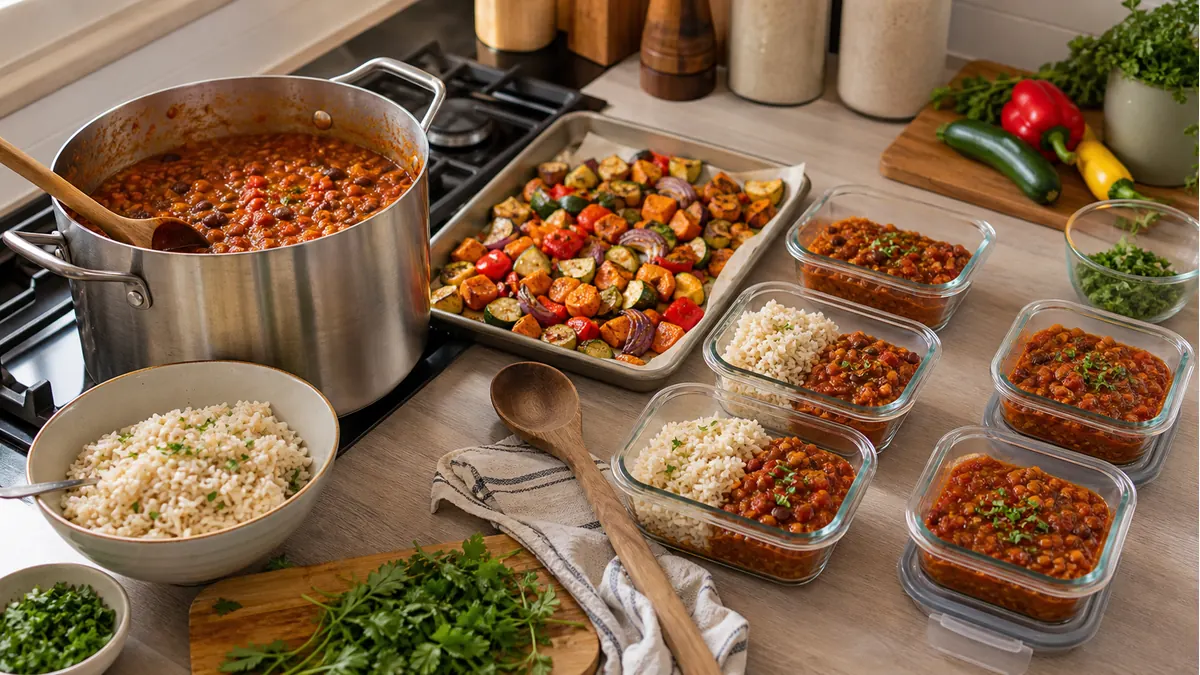
Follow this sequence to have five complete meals ready with the minimum active cooking time:
- 0:00 — Start the rice. Add 500 g brown rice to a large saucepan with 1 litre of water. Bring to the boil, reduce to a simmer, cover. Brown rice takes 25–30 minutes.
- 0:05 — Season the chicken. Remove 1 kg frozen chicken breast from packaging (or use fresh). Toss in olive oil spray, garlic powder, salt, pepper, and dried mixed herbs. Spread across a large baking tray.
- 0:10 — Put the chicken in the oven. Bake at 200°C (fan 180°C) for 25–30 minutes (fresh) or 35–40 minutes (from frozen). Chicken is cooked when internal temperature reaches 75°C.
- 0:15 — Prepare the chickpea and tomato sauce. Fry 3 crushed garlic cloves in olive oil spray. Add the chickpeas (drained), tinned tomatoes, salt, pepper, and a teaspoon of cumin. Simmer for 15–20 minutes. This makes 5 portions of a protein-rich tomato sauce.
- 0:35 — Check the rice. Stir, add water if needed, replace lid.
- 0:40 — Check the chicken: fresh chicken should be done now, frozen by about 0:50. Once it reaches 75°C in the thickest part, remove it, rest for 5 minutes, then slice into portions.
- 0:50 — Cook the frozen veg. Microwave or steam 1 kg frozen mixed vegetables in two or three batches, about 5 minutes each.
- 1:05 — Portion everything. Into each of 5 containers: a portion of brown rice, a portion of sliced chicken, a portion of veg, and a ladle of chickpea sauce. Once cooled, refrigerate Monday's box and freeze the other four; move each one to the fridge to defrost the night before.
- 1:20 — Prepare breakfasts (optional). Make 2 overnight oat jars for Monday and Tuesday: 60 g oats + 150 ml skimmed milk + 100 g Greek yogurt + frozen berries. Seal and refrigerate, and mix the rest the night before.
- 1:30 — Done. Clean up. Total active cooking time: approximately 45 minutes.
Storage and Food Safety
For UK food-safety guidance, cooked leftovers kept in the fridge should be eaten within 2 days. Cooked rice is stricter: cool it quickly, refrigerate promptly, use it within about 24 hours, and reheat it once until steaming hot. Do not leave food sitting at room temperature for more than 1–2 hours.
Freeze later-week portions straight after cooking and cooling. Cooked chicken, stews and many vegetable mixes freeze well; portion into individual containers on Sunday for use later in the week or the following week. Defrost in the fridge overnight.
Scaling up: Advanced Batch Cooking
Once you are comfortable with a basic batch cook, scale up by adding a second protein (a batch of salmon or turkey mince), preparing soups or stews that freeze well, or making overnight oats for breakfast. A three-hour Sunday session can prepare all breakfasts, lunches, dinners, and snacks for the entire week, with later-week portions frozen, reducing daily cooking time to near zero.
Use our free meal plan generator to get a complete week of meals with a structured shopping list tailored to your calorie target and preferred UK supermarket.
The Sunday Session, Timed
Ninety minutes is the realistic figure for a week of lunches, and the order matters more than the speed. Start whatever takes longest and needs no attention - the oven tray, the rice, the thing in the slow cooker - then do the knife work while it runs. Prepping in the order the recipes are written is how a ninety-minute session becomes three hours.
Do the washing up as you go rather than at the end. The single biggest reason people stop batch cooking is not the cooking, it is standing in a wrecked kitchen at nine on a Sunday evening, and that is entirely avoidable by cleaning during the gaps you are already waiting through.
What Actually Freezes Well
Anything wet and cooked: stews, chilli, curry, bolognese, soup, dhal, cooked mince, portioned rice. These come back essentially as they went in. Cooked pasta, potatoes in chunks and creamy sauces are the awkward middle - edible but changed. Salad leaves, raw tomato, fried food and anything meant to be crisp do not survive, and no technique fixes it.
Freeze flat in portions rather than in one block. A flat portion freezes faster, stacks in the space you have and thaws in a fraction of the time, which is the difference between using the freezer and slowly filling it. Cool food before it goes in, leave headroom for expansion, and label with the date and the number of portions.
The point of a freezer buffer is not the cooking - it is having four meals in reserve for the weeks when the Sunday session does not happen. Aim to cook one extra portion of whatever you are already making rather than holding a separate freezer-cooking day.
One-Pan Cooking When You Do Not Want a Session
Not every week has ninety minutes in it. A tray of protein, a firm vegetable, and a starch that roasts - chicken thighs with peppers and potatoes, sausages with root vegetables, halloumi and chickpeas with squash - is one pan, one wash, and about forty minutes of which thirty-five is oven time.
The way to stop tray cooking becoming samey is to change the finish rather than the ingredients: a different spice rub before it goes in, and something sharp after it comes out - lemon, yoghurt, pickled onion, chilli oil. The tray is a format, not a recipe, and treating it as one is what makes it survive repetition.
Frequently Asked Questions
How long does batch-cooked food last in the fridge?
For UK food-safety guidance, eat cooked leftovers kept in the fridge within 2 days, and use cooked rice within about 24 hours. Freeze later-week portions rather than holding a full working week in the fridge.
What is the best food to batch cook?
The best batch-cook foods reheat well and freeze well: chicken breast, stews, chilli, soups, roasted vegetables, lentils and bean dishes. Cook rice in smaller batches or cool it quickly and use chilled rice within about 24 hours.
How much does a week of batch cooking cost?
A batch cook based on chicken, rice, eggs, frozen veg, and tinned chickpeas costs approximately £10–15 for the protein and carb components at Aldi. Including dairy (Greek yogurt, cottage cheese) and fresh vegetables brings a full week to £23–28 — covering all main meals for under £1 per meal.
How long should a batch cooking session take?
About ninety minutes for a week of lunches once you have done it a few times. Start the longest hands-off thing first and do the knife work while it cooks; that ordering saves more time than working faster does.
What should I not freeze?
Salad leaves, raw tomato, anything fried or crisp, and most creamy sauces. Wet cooked food - stews, curries, chilli, soup, bolognese - freezes and returns almost unchanged.
Want this as a full 7-day plan?
We'll email the matching plan, its shopping list and a printable copy.
We'll send: Low Effort Meal Plan — 1,500 kcal
Want a new plan every week? Join the MealPrep+ waitlist.
Find Your UK Supermarket Meal Plan
Answer seven quick questions to find a realistic weekly plan for your supermarket, calorie target, budget and dietary preferences.
Find My Meal Plan →