Muscle building, at a higher daily calorie target. This 7-day plan targets 2,000 kcal/day and averages 114g of protein, built from ingredients stocked at any major UK supermarket for an estimated £50–90/week. Both protein and carbohydrate run high in this plan — it is built for training performance and recovery, not calorie restriction, so there is no need to trade one macro off against the other.
Adjust Household PortionsCurrently 1 person · 1 cook portions
Your 7-Day Meal Plan
Monday
2000 kcal per person105g protein · 201g carbs per person
Breakfast507 kcal · 9g protein · 20g carbs · 5 min
Chia Seed Pudding with Mango
Made with chia seeds, coconut milk, mango chunks.
Recipe
Ingredients
30g chia seeds
175ml coconut milk
90g mango chunks
vanilla extract, to taste
Method
Stir chia seeds and coconut milk together in a lidded jar or container.
Stir well, cover and chill for at least 4 hours or overnight.
Stir again before eating, then add mango chunks and vanilla extract, to taste. Loosen with a splash of coconut milk if needed.
Lunch433 kcal · 27g protein · 71g carbs · 15 min
Lentil and Roasted Vegetable Soup
Made with green lentils, courgette, red pepper.
Recipe
Ingredients
90g green lentils
1 courgette
1 red pepper
¾ onion
425ml vegetable stock
¾ tsp cumin
Check the label for: Celery, Cereals containing gluten, Soybeans. Worked out from generic ingredient names — always read the product label.
Method
Peel and chop onion, courgette and red pepper into even pieces.
Heat the oven to 200°C (180°C fan) and roast courgette and red pepper for 25-30 minutes, until tender and caramelised at the edges. Meanwhile, soften onion in a large non-stick pan over medium heat, adding a splash of water if the pan starts to stick.
Stir in vegetable stock and cumin, then add green lentils and simmer gently until tender and thickened.
Stir the roasted courgette and red pepper into the soup.
Taste, season and portion for serving.
Dinner589 kcal · 42g protein · 59g carbs · 35 min
Lean Pork Loin with Roasted Root Vegetables
Made with pork loin, parsnip, carrot.
Recipe
Ingredients
175g pork loin
1 medium parsnip
2 medium carrots
¾ medium sweet potato
¾ tbsp olive oil
¾ tsp rosemary
Method
Heat the oven to 200°C (180°C fan).
Cut the parsnips, carrots and sweet potato into even chunks, toss with the olive oil and rosemary, and roast for 30-35 minutes, turning halfway.
Meanwhile, brown the pork loin all over in a hot non-stick pan, then add it to the tray for the final 15-20 minutes, until cooked through with no pink juices.
Rest the pork for 5 minutes, then slice and serve with the roasted vegetables.
Snack82 kcal · 14g protein · 5g carbs · 1 min
Skyr High-Protein Yogurt
Made with skyr.
Recipe
Ingredients
125g skyr
Allergens in this meal: Milk. Worked out from generic ingredient names — always read the product label.
Method
Put skyr in a bowl.
Stir gently and serve.
Eat straight away, or cover and chill for later the same day.
Snack389 kcal · 13g protein · 46g carbs · 10 min
No-Bake Peanut Butter Oat Protein Balls
Made with rolled oats, peanut butter, honey.
Recipe
Ingredients
40g rolled oats
1 tbsp plus 2 tsp peanut butter
¾ tbsp honey
¾ tsp chia seeds
Allergens in this meal: Cereals containing gluten, Peanuts. Worked out from generic ingredient names — always read the product label.
Method
Put rolled oats, peanut butter, honey and chia seeds in a bowl and mix to a thick, sticky dough that holds together when pressed.
If the mixture is too dry to hold, add a teaspoon of water or milk at a time; if too wet, add a little more oats.
Roll into even balls, roughly a heaped tablespoon each.
Chill in the fridge for at least 30 minutes to set without any baking.
Keep refrigerated in an airtight container and eat within 5 days.
Estimated cost: £50–90/week for 1 person from Generic UK supermarket. Calories and macros remain per person, while shopping quantities are scaled for the household.
0 of 84 items tickedSaved on this device
Protein
Carbs & Grains
Vegetables
Plant-Based Milks & Alternatives
Dairy & Eggs
Fruit
Herbs & Spices
Condiments & Oils
Tins & Jars
Extras
Sponsored #ad - container setup
Container setup for this plan
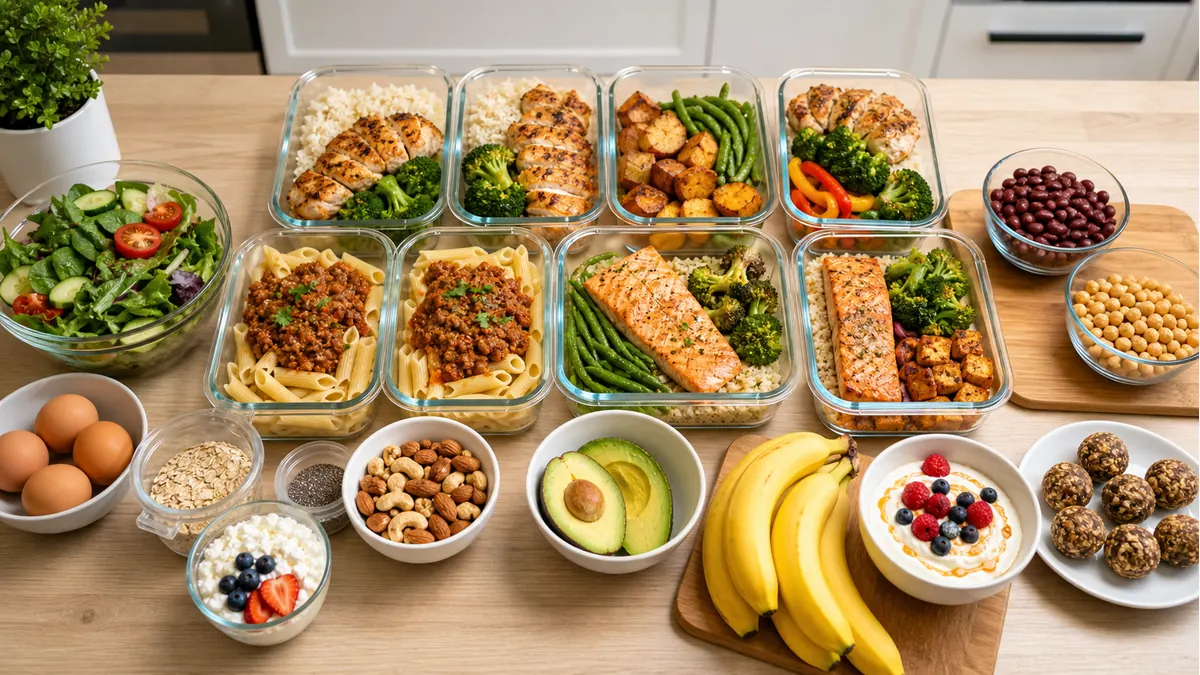
This plan has about 19 prep-friendly meals. Start with 10 main containers, 4 small sauce or snack tubs, and 2 freezer tubs.
Use 2 five-container glass packs to provide at least 10 main meal spaces, then add the separate small tubs shown above.
RecommendedMid-range glass setup
Best for regular weekday lunches, reheating at work, curry, chilli, pasta, and repeat washing.
Material
Glass
Price and availability
Check Amazon UK before buying
This plan includes saucy or reheated meals, so choose containers with secure, leak-resistant lids. If using plastic, check that it is suitable for reheating and follow the product instructions.
As an Amazon Associate I earn from qualifying purchases. Product prices and availability can change on Amazon UK.
The One Tool This Plan Assumes
The protein and calorie figures on this plan are calculated from weighed portions. Estimating by eye is where most high-protein plans quietly drift, so a set of digital scales is the difference between following this plan and approximating it. Any scale works — this is simply a cheap, accurate one.
As an Amazon Associate I earn from qualifying purchases. Product prices and availability can change on Amazon UK.
Kitchen scaleBudget
Salter Arc Digital Kitchen Scale
A slim, add-and-weigh digital scale with a 3kg capacity, useful for portioning rice, protein and vegetables precisely rather than guessing by eye.
Best forWeighing portions accurately for calorie or macro tracking
Good to knowNo liquid measurement mode; for sauces and liquids, a scale with an Aquatronic function is more useful.
Built from ingredients stocked by every major UK supermarket, using average UK pricing rather than one retailer.
Value rangeOwn-brand equivalents at any major retailer
What Generic UK supermarket is good for here
Ingredients are chosen from staples that most UK supermarkets carry, so the plan should work wherever you shop, though ranges still vary by store.
Easy to swap to a specific retailer later without changing the meals.
Costs reflect a mid-market average rather than the cheapest or priciest store.
Worth knowing before you shop
Shopping entirely at a discounter will usually come in below the estimate; a premium store above it.
No loyalty-scheme pricing is assumed.
Retailer details checked 2026-07-20. Ranges and loyalty schemes change — the weekly cost estimate above is based on the plan's budget tier, not on live prices at this store.
Swaps & Suggestions
💰 Make it cheaper
Buy own-brand rolled oats, rice, pasta and tins — nutritionally identical to branded, at any supermarket
Replace fresh salmon with tinned mackerel or sardines in brine (saves ~£2–3/week)
Buy dried pulses (lentils, chickpeas, black beans) and cook in bulk rather than tinned — cheaper per portion
Use frozen chicken breast instead of fresh (saves ~£1.50/week, same protein)
Swap fresh berries for frozen mixed berries (same nutrients, fraction of the cost)
💪 Increase protein
Add a post-workout combination of fast carbs and protein (banana and whey, or chocolate milk) after harder sessions
Use an extra portion of chicken, fish or tofu on higher-training days rather than cutting carbs to make room
Greek yogurt with fruit and granola covers both protein and carb needs in one snack
🥦 Make it vegetarian
Replace chicken with Quorn fillets or diced firm tofu
Swap beef mince for tinned green lentils or plant-based mince
Use halloumi or feta instead of meat in lunch salads
Substitute eggs or cottage cheese for fish-based meals
Frequently Asked Questions
How much does this muscle gain plan cost per week?
This plan is designed for a generic UK supermarket and is estimated at £50–90 per week for one person at typical UK prices, depending on what you already have at home. Buying in bulk and choosing own-brand items can reduce this further.
How much protein does this plan provide per day?
This plan averages 114g of protein per day across the week, based on the meals actually selected — in line with general UK guidance of roughly 0.8–1.6g per kg of bodyweight for active adults.
How is this different from a generic muscle gain plan?
Plenty of muscle gain plans share the same 2,000 kcal target — the difference here is that both protein and carbs are set high together, rather than trading one off against the other.
Can I print this muscle gain meal plan or save it as a PDF?
Yes. Use the export / print PDF button on the plan page. The printable version summarises all 7 days at 2,000 kcal/day, the generic UK supermarket shopping list, and your chosen household portion sizes.
Is this plan suitable for meal prep?
Most recipes in this plan scale well and reheat easily. Soups, stews, and grain dishes are ideal for making in larger batches to save time midweek.
Is this plan suitable for beginners?
Yes. Recipes are rated Standard (20–30 min/day) and use ingredients available at a generic UK supermarket — no specialist equipment or advanced technique is needed.